
Low Flow at One Faucet: Compare Hot, Cold, and Aerator
On this page
Quick answer
If only one faucet has low flow, first compare nearby fixtures and test that faucet on cold, hot, and mixed settings. If both sides are weak and the stream is uneven, the aerator may contain debris, but remove it only according to the faucet manufacturer’s instructions and with the correct tool. Stop if you find a leak, damaged valve, stuck part, or uncertain connection.
This guide is for a simple homeowner observation in the United States. It does not cover whole-home pressure adjustment, private wells, fire systems, commercial plumbing, or opening concealed supply components.

Confirm that the problem is local
“Low pressure” and “low flow” are often used interchangeably, but a weak stream at one outlet does not prove that building water pressure is low.
- Check the same room. Run another sink, shower, or tub briefly and note whether its flow appears normal.
- Check another floor or area. If several fixtures changed at the same time, the cause may be broader than one faucet.
- Ask what changed. Note recent plumbing work, a water shutdown, utility work, freezing weather, a new filter, or a new faucet.
- Look before touching. Inspect under the sink and around the faucet for moisture, corrosion, swollen cabinet material, or a supply line that appears kinked.
- Check connected equipment. A pull-down spray head, side sprayer, touch control, filter, or instant hot-water device can change the troubleshooting path.
If multiple fixtures are weak, contact the water utility, building manager, well professional, or licensed plumber as appropriate. Do not adjust a pressure-reducing valve or well control based on one faucet symptom.
Lon Tharaldson Plumbing and Heating LLC
ShorewoodHennepin CountyMinnesota
5680 Manitou Rd, Shorewood, MN 55331, USA
Compare hot and cold flow
Use the faucet handle normally. Do not force it beyond its stops.
- Cold only: Note stream strength, shape, noise, and whether it pulses.
- Hot only: After allowing normal warm-up time, compare it with cold. Avoid scalding water.
- Mixed: Check whether the stream improves, stays weak, or changes when the handle moves through its range.
- Spray modes: On a kitchen faucet, compare stream and spray only if the control operates normally.
If only hot or only cold is weak, the restriction may be on that side of the faucet, its supply path, or a connected device. If both are equally weak, a shared outlet component such as the aerator or spray-head screen becomes a more plausible check. These patterns narrow the question; they do not diagnose the part.
Check the aerator safely
The aerator is the outlet component that shapes the stream and may limit flow. Some aerators unscrew by hand; recessed “cache” styles need a model-specific key. Pull-down spray heads may use a screen in a different location.
- Identify the faucet. Find the brand and model from paperwork, a label, or the manufacturer’s identification process.
- Read its maintenance instructions. Confirm whether the aerator is removable and which tool and direction apply.
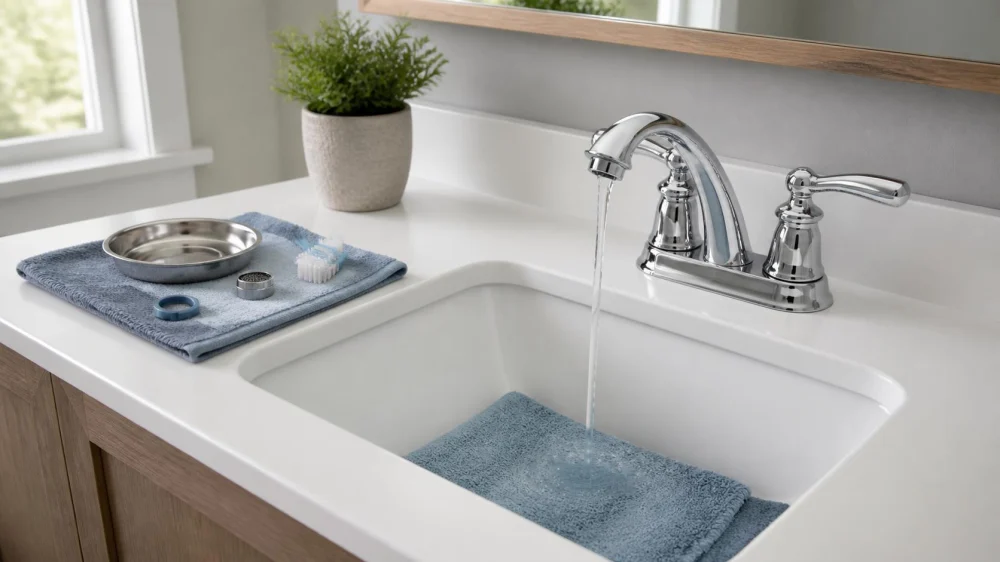
- Close the drain. Place a towel in the sink so small parts cannot fall into the drain or damage the basin.
- Protect the finish. Do not grip a decorative aerator with bare pliers. Use the supplied key or the method the manufacturer specifies.
- Keep parts in order. Photograph the orientation of washers and screens. Do not remove a flow regulator or alter the assembly.
- Rinse loose debris. Use a soft brush or the cleaning method specified for that exact product. Avoid harsh chemicals that can damage finishes or plastic.
- Reinstall completely. Replace every component in its original orientation and check the stream and surrounding area for leaks.
Do not run an unfamiliar faucet without its aerator unless the manufacturer directs a flushing procedure; some models require specific steps to protect internal parts and contain spray.
What to record for a plumber
A short, specific record can reduce guesswork:
- Faucet brand, model, age if known, and whether it has a sprayer, filter, or electronic control.
- When low flow began and whether it was sudden or gradual.
- Whether cold, hot, mixed, stream, and spray behave differently.
- Which other fixtures are normal or affected.
- Recent shutoffs, plumbing work, filter changes, or utility notices.
- Photos of the stream and any visible corrosion, kink, leak, or damaged part.
- What the manufacturer’s instructions allowed you to check and whether cleaning changed the symptom.
Do not conceal a leaking cabinet or wet wall before assessment. If water is near an outlet, appliance wiring, or electrical equipment, avoid the area and contact qualified help.
Limits and stop conditions
Stop and call a plumber if a shutoff valve leaks, a supply line is damaged, a connection moves, the faucet body is loose, flow changed after freezing, debris repeatedly returns, or the correct aerator tool is unavailable.
Do not force shutoff valves. Old or corroded stops can begin leaking when disturbed. A valve that will not move normally needs professional evaluation.
Do not defeat water-saving parts. Removing a regulator can violate product requirements, waste water, create splash, or damage performance. Replace only with compatible parts specified by the manufacturer.
Watch for scalding. Low flow on one side can change mixed-water behavior. Test carefully and keep children away until the cause is resolved.
Sources and evidence notes
Faucet maintenance is model-specific. Delta’s official low-flow guidance lists a clogged aerator or shower-head restrictor as one possible cause and provides a manufacturer-directed flushing approach for applicable products. See Delta Faucet’s low-pressure troubleshooting guidance.
Manufacturer installation and maintenance documents also show that some aerators require supplied tools and that internal repair steps begin with shutting off water. Use the document for the exact model; a procedure for one faucet should not be copied to another.
Frequently asked questions
Does low flow at one faucet mean the house pressure is low?
Not by itself. Compare other fixtures. Normal flow elsewhere suggests a local faucet or supply-path issue, while several affected fixtures justify a broader pressure or supply investigation.
Can I remove the aerator with pliers?
Only if the manufacturer explicitly specifies a protected method. Bare pliers can damage the finish or deform the part. Recessed aerators often need a matching key.
Should I remove the flow restrictor?
No. Clean and reinstall approved components according to the product instructions. Do not alter water-saving or performance parts.
Why is only the hot side weak?
That pattern suggests the issue may be specific to the hot-side path, valve, cartridge, supply line, or connected equipment. It is not enough to identify the exact part. Record the comparison and contact a plumber or manufacturer support.
Why did the aerator clog again?
Recurring debris may come from a deteriorating component, recent supply work, mineral buildup, or another source that needs investigation. Repeated cleaning without finding the source is not a complete repair.
Conclusion and next steps
Confirm whether the symptom affects one faucet or several, compare hot and cold, and inspect for visible leaks before removing anything. Clean an aerator only with the exact manufacturer procedure and tool, reinstall every part, and stop if the result is uncertain. A clear record of affected settings, nearby fixtures, and recent work gives a plumber a better starting point.

 Drain Doctor LLC4.0 (72 reviews)
 Sewer and Drain Solutions5.0 (27 reviews)
 Hoffmann Brothers4.0 (675 reviews)
 Parson Plumbing and Drains5.0 (360 reviews)
 Hickory Creek Plumbing L.L.C.5.0 (42 reviews)
 LOVE PLUMBING & ROOTER0.0 (0 reviews)
 Why Your Shower Alternates Between Hot and Cold – Causes and Solutions
 How to Replace a Sink Overflow Tube: A Complete Step-by-Step Guide
 Showerhead Sprays Sideways: Check Buildup, Seals, and Fit
 How to Replace the Gasket on Your Toilet Tank and Prevent Leaks
 How to Prevent Plumbing Emergencies in the Winter Months
 The Best Plumbing Solutions for Homeowners with Hard Water