
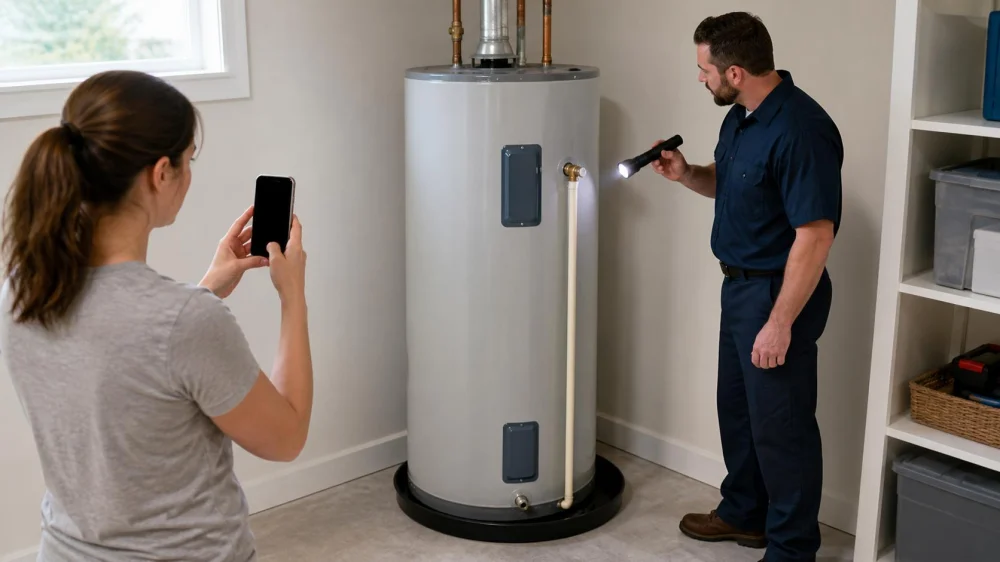
Water Heater Relief Valve Drips: Never Cap or Plug It
A temperature-and-pressure relief valve is a safety device, not an ordinary faucet. Water at its outlet can reflect thermal expansion, excessive pressure or temperature, debris, a valve problem, or another system condition. Because the valve protects against dangerous pressure, do not cap, plug, clamp, block, or remove its discharge pipe. Keep people away and call a qualified plumber.
Quick answer
Keep everyone away from the valve outlet and discharge pipe because released water or steam can cause severe burns. Do not touch the valve lever, cap the pipe, tighten the valve, or change thermostat or pressure settings. Photograph the setup from a safe dry location, note whether dripping is continuous or follows heating cycles, and call a licensed plumber promptly. Shut down or isolate the heater only according to manufacturer or emergency-professional instructions. Call emergency services for steam, violent discharge, tank deformation, fire, gas odor, or immediate danger.
Identify the source from a distance
The relief valve is usually mounted near the upper portion of a storage water heater and connected to a discharge pipe. Designs vary, so do not assume every nearby fitting is the valve. Water may instead come from a pipe joint, drain valve, condensate line, pan, supply connector, or the tank itself.
Observe without placing a hand under the pipe. Hot water can be clear and appear harmless. Look for the exact wet starting point, mineral tracks, corrosion, a full drain pan, or moisture on surrounding surfaces.
Do not remove insulation, covers, or pipe fittings. Electric shock, gas, combustion, hot surfaces, and scalding water can be present.
Roto-Rooter Plumbing & Water Cleanup
166 W Washington St Ste 375, Chicago, IL 60602, USA
Do not defeat the safety device
Never cap or plug a relief-valve outlet or discharge pipe. Do not install a shutoff between the tank and valve, clamp the lever, reduce the pipe, or route it upward to stop dripping. These actions can prevent safe pressure relief.
Do not repeatedly operate the test lever to “flush” a leak unless the heater manufacturer and qualified professional direct a controlled test. A valve can fail to reseat, and discharge can be dangerously hot.
Do not replace the valve with a random part. Temperature, pressure, capacity, connection, certification, and installation requirements must match the heater and code.
Record the pattern
Note when dripping begins: during burner or element operation, after a long hot-water draw, overnight, after plumbing work, or continuously. Record duration, approximate amount, visible steam, sounds, and changes in water pressure or temperature.
Take photos of the full heater, valve, discharge route, drain pan, model information, nearby shutoffs, and wet area without touching hot components. Save recent utility, expansion-tank, pressure-regulator, or heater service records.
Do not collect scalding water to measure it. A remote visual estimate and repeated photos are sufficient for the first call.
Protect people and property
Keep children, pets, and stored belongings away. Do not stand in front of the pipe outlet or block it with a bucket. Mark the area and prevent slips without restricting the discharge path.
If water threatens electrical equipment, do not enter the wet area or touch panels, cords, or the heater. Call emergency or utility professionals. For gas odor, leave the building without operating switches and follow the gas utility’s emergency instructions.
A drain pan or floor drain may limit damage but does not correct the cause. Do not route discharge outdoors where it creates ice, burns, hidden damage, or a blocked line without professional design.
Call with useful information
Tell the plumber the heater type, approximate age, fuel, model if safely visible, valve location, discharge-pipe condition, leak pattern, recent plumbing work, pressure-regulator or expansion-tank history, and whether water temperature changed.
Describe corrosion, tank bulging, banging, rumbling, steam, gas odor, electrical symptoms, or water near wiring. Ask whether the heater should remain operating and follow only qualified, product-specific instructions.
Verify licensing and permits required locally. Relief-valve and discharge piping work is safety-critical and may require inspection.
Recognize urgent danger
Leave the area and seek emergency help for steam discharge, a violently flowing valve, a bulging or deformed tank, fire, gas odor, smoke, sparking, electrical arcing, flooding near electricity, or signs of imminent rupture.
Call emergency services for burns, breathing difficulty, collapse, carbon-monoxide alarm, or another medical emergency. Cool a thermal burn with cool running water and follow emergency guidance; do not apply ice or household remedies.
Do not return to adjust controls or retrieve belongings until responders say it is safe.
Prepare for professional diagnosis
A plumber may check system pressure, thermal expansion control, temperature settings, valve rating and condition, discharge piping, heater controls, installation, and tank integrity. Dripping can have more than one cause.
Ask for the diagnosis, measurements, replaced part details, corrected piping, permit or inspection record, and safe operating instructions in writing. Request a demonstration of owner checks only if the manufacturer recommends them.
After repair, monitor the area from a safe location and keep the valve and discharge termination unobstructed.
Frequently asked questions
Can I put a cap on the pipe until the plumber arrives?
No. Never obstruct a relief-valve discharge.
Should I lift the test lever?
Not as an improvised response. Follow manufacturer and qualified professional instructions.
Is a small drip harmless?
It still needs prompt diagnosis because pressure, temperature, expansion, or valve condition may be involved.
Can I place a bucket under it?
Do not block or enclose the outlet. Ask a professional about safe temporary property protection.
Next steps
Keep clear, do not touch or block the valve, record the pattern, protect the area without obstructing discharge, and call a qualified plumber. Escalate immediately for steam, violent flow, deformation, fire, gas odor, electricity, or injury.
 Mr. Rooter Plumbing of Hendersonville4.0 (649 reviews)
 Roto-Rooter Plumbing & Water Cleanup4.0 (887 reviews)
 G & R Plumbing Inc3.0 (72 reviews)
 Rescue Plumbing4.0 (84 reviews)
 Wellington Sewer & Drains LLC4.0 (8 reviews)
 Local 5724.0 (53 reviews)
 How to Clean Sediment Build-Up in Household Pipes
 How to Test Your Plumbing for Hidden Leaks and Save Money
 How to Clear Stubborn Hair Clogs from Bathroom Drains – Effective Solutions
 How to Replace a Float Valve in a Rain Barrel System
 How to Eliminate Corrosion in Hard Water Homes
 How to Choose Fixtures for a Water-Smart Bathroom