
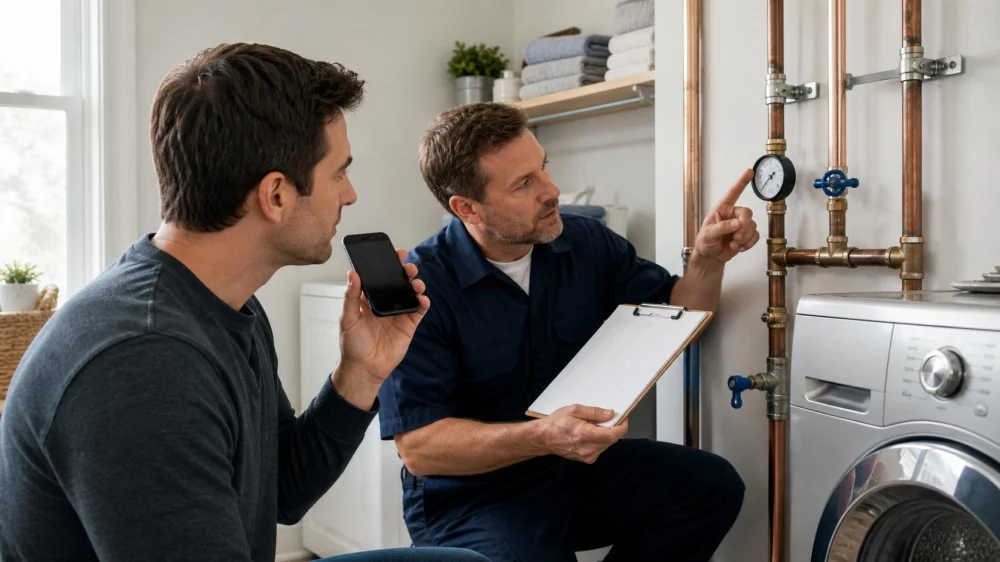
Water Hammer Noise: Record Fixtures and Timing
On this page
- Describe the sound precisely
- Identify the triggering fixture
- Record timing and pattern
- Check for visible leaks and movement
- Avoid opening walls or adjusting pressure
- Consider valves, appliances, and pipes
- Prepare a useful video
- Ask a plumber to test the system
- Review the repair scope
- Verify results after service
- Noise investigation checklist
Water hammer is a pressure-related shock that can create a bang when moving water stops or changes direction quickly. Homeowners also use the term for pipe movement, valve chatter, appliance noise, thermal expansion, and other plumbing sounds. Recording the trigger and pattern helps a plumber distinguish possibilities before recommending a repair.
Do not open walls, clamp hidden pipes, adjust a pressure regulator, or add devices based only on the sound. Plumbing systems differ, and an incorrect change can create leaks or unsafe pressure. Check for visible danger, document accessible conditions, and use a licensed plumber for testing and diagnosis.
Make one household member responsible for the log so descriptions stay consistent. Ask others to report the room and fixture without recreating the event. If the noise occurs overnight, record the appliance cycle or timer that may have run rather than repeatedly waking the system for tests.
Signature Plumbing & Drain Cleaning LLC
Villa RidgeFranklin CountyMissouri
697 Hwy AT, Villa Ridge, MO 63089, USA
Describe the sound precisely
Write whether you hear one sharp bang, several knocks, rattling, vibration, squealing, ticking, or a low thump. Note where it seems loudest, while recognizing that sound travels through framing and pipes. The apparent wall location may not be the source.
Describe volume and whether the sound can be felt through a cabinet, floor, or wall. Avoid exaggerating with a diagnosis. “One bang behind the laundry wall when the washer stops filling” is more useful than “all the pipes have water hammer.”
Identify the triggering fixture
Observe whether the sound follows a faucet, toilet fill valve, washing machine, dishwasher, ice maker, irrigation valve, shower control, or another fixture. Test only normal operation and stop if a leak, severe vibration, or electrical concern appears.
Compare hot and cold sides at an accessible faucet. Note whether slowly closing a manual faucet differs from an appliance valve that closes automatically. Do not cycle a malfunctioning appliance repeatedly merely to reproduce the noise.
Record timing and pattern
Log the date, time, fixture, water temperature, flow duration, and exact moment of the sound: opening, steady flow, closing, refilling, heating, or cooling. Record whether other fixtures were running and whether the event occurs every time or intermittently.
Look for connections to utility work, a new appliance, valve replacement, renovation, pressure change, season, or overnight operation. A short pattern log across several ordinary uses is more informative than dozens of forced tests in one hour.
Check for visible leaks and movement
Inspect accessible shutoff valves, supply tubes, appliance hoses, exposed pipes, ceilings, and cabinets for droplets, staining, swelling, or movement. Keep away from wet electrical equipment. If water is spraying or pooling rapidly, use the known safe shutoff and call for urgent help.
Do not hold a moving pipe while a fixture operates. A loose pipe can pinch fingers or stress joints. Photograph the area from a safe position and tell the plumber which pipe or connector appeared to move.
Avoid opening walls or adjusting pressure
Do not cut drywall to chase a sound without a plan. Hidden pipes, wires, structure, insulation, and hazardous materials may be present. A plumber can use system knowledge and testing to narrow the area before access is created.
Do not turn a pressure-reducing valve or water-heater component casually. System pressure should be measured with suitable equipment and interpreted with local code and appliance requirements. Excessively low pressure can create a different service problem.
Consider valves, appliances, and pipes
Fast-closing appliance solenoids can create a different trigger from a hand faucet. Worn fill valves, loose pipe supports, failed components, high pressure, and missing or ineffective arrestors are among the issues a plumber may investigate. The sound alone cannot choose among them.
Thermal expansion and contraction can produce ticks or movement around hot-water use. A plumber may review the water heater, expansion control, check valves, and system type. Never cap a relief valve or alter safety piping to address noise.
Prepare a useful video
Record from a safe dry location. Begin by naming the fixture and normal action, then capture the sound and a wide view of accessible piping. Avoid showing addresses, account numbers, faces, or private conversations when sharing the file.
A video should supplement, not replace, an inspection. Sound compression can alter pitch and direction. Tell the plumber where the phone was placed and whether the event felt stronger than it sounds in the recording.
Ask a plumber to test the system
Provide the log, videos, recent work, property age, water-heater information, and affected fixtures. Ask the plumber to measure static and flowing pressure as appropriate, inspect valves, reproduce the event safely, and evaluate visible pipe support.
In a multifamily building, involve management because pressure controls and risers may be shared. Do not alter common plumbing. The plumber may need access to another mechanical area or coordinate a shutdown.
Review the repair scope
A proposed repair might involve a fixture valve, appliance connection, properly selected hammer arrestor, pressure regulation, pipe support, expansion control, or another cause-specific step. Ask what evidence supports the recommendation and which noise it is expected to change.
Confirm shutdown, access, parts, code permits, wall restoration, price, warranty, and testing. An arrestor placed anywhere in the system is not a universal cure; location and sizing should follow professional design and product instructions.
Verify results after service
Ask the plumber to demonstrate normal operation of the triggering fixture and inspect disturbed connections under pressure. Repeat only the ordinary actions from the original log. Note whether the bang, vibration, or secondary sound changed.
Recheck accessible areas for leaks after several uses. Continue the log briefly because intermittent problems may not appear immediately. Contact the plumber if the sound returns, a new symptom develops, or pressure and flow feel abnormal.
Noise investigation checklist
Record the sound, location, fixture, hot or cold side, opening or closing event, other water use, appliance cycle, recent work, visible movement, leakage, and video position. Keep all testing within normal safe use.
A good water-hammer investigation starts with a trigger, not a guessed device. Precise observations let the plumber measure pressure, inspect the relevant valve and piping, and choose a targeted repair. That reduces unnecessary wall access and avoids creating a new problem while chasing a traveling sound.
 Garrels Company5.0 (9 reviews)
 Mr. Rooter Plumbing of Northwest Indiana4.0 (353 reviews)
 Royal Flush Plumbing4.0 (74 reviews)
 Maximum Flush Sewer and Drain5.0 (19 reviews)
 Pro Plumbers Inc Long Beach, CA4.0 (144 reviews)
 JOSH-ROOTER Plumbing and Sewer5.0 (152 reviews)
 Why Your Water Heater Is Leaking and How to Fix It
 How to Maintain Your Plumbing System to Avoid Costly Repairs
 How to Prevent Clogged Drains: Everyday Habits You Should Adopt
 How to Fix a Sink That Squirts Water When Used
 How to Fix a Leaky Showerhead in Just a Few Steps
 Step-by-Step Guide to Installing a Radiant Floor Heating Plumbing Loop