
Sump Pump Discharge Line Checklist: Route Water Away Safely
On this page
- Quick answer
- Understand the discharge system
- Trace the full route
- Inspect the indoor section
- Inspect the exterior outlet
- Check where the water goes
- Reduce freezing risk
- Prevent erosion and nuisance water
- Avoid improper connections
- Test the pump safely
- Plan for power and pump failure
- When to call a professional
- Seasonal checklist
- Frequently asked questions
- Next steps
Quick answer
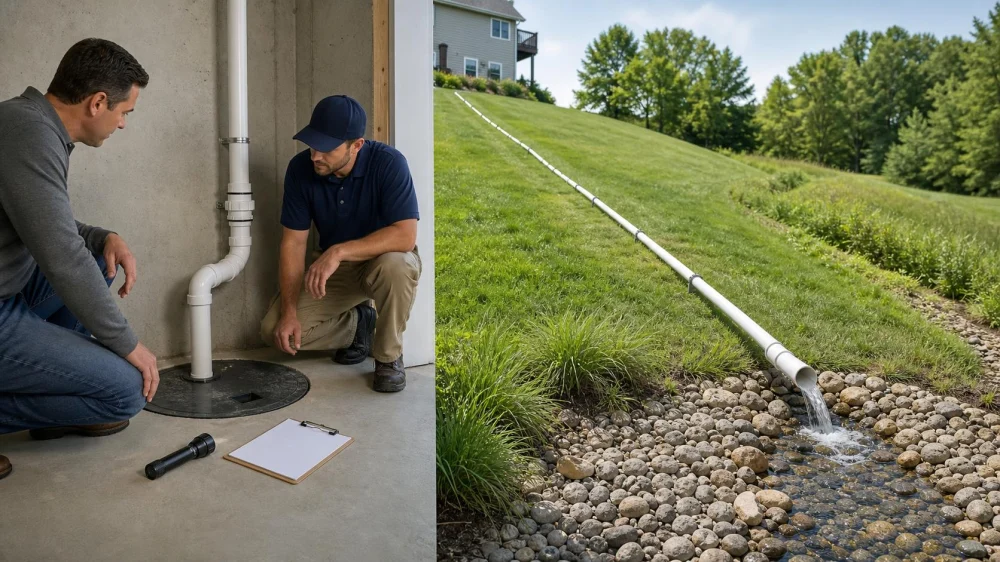
A sump pump discharge line should carry water from the sump basin to an approved location that drains away from the foundation without flooding neighbors, sidewalks, septic areas, or public infrastructure. Inspect the visible pipe, supports, joints, check valve, wall penetration, exterior route, outlet, slope, and erosion protection.
Keep the outlet clear of soil, mulch, leaves, snow, ice, nests, and stored objects. Listen for unusual cycling and watch the outlet during a controlled test if conditions are safe. Do not connect or redirect the line into a sanitary sewer, storm system, street, or another property without confirming local rules and professional approval. Call a plumber or drainage professional for leaks, repeated freezing, backflow, short cycling, buried-line uncertainty, or water returning toward the house.

Understand the discharge system
Groundwater enters a sump basin and activates a pump when it reaches the float setting. The pump pushes water through a discharge pipe. A check valve commonly reduces water flowing back into the basin after the pump stops.
The line may rise vertically, pass through a wall or rim joist, then continue above or below ground to a surface outlet, dry well, approved drainage feature, or other legal destination. Designs vary with climate, soil, property slope, and local code.
The pump, basin, electrical supply, pipe size, fittings, check valve, air-relief provisions, and outlet work as a system. Changing one part can affect cycling, noise, freezing, and pump load.
A discharge line is not the same as a foundation-drain inlet. Do not assume every pipe near the basement wall has the same direction or purpose.

Trace the full route
Start at the sump basin without removing a sealed or secured lid. Follow the visible discharge pipe upward and toward the exterior. Photograph fittings, supports, valves, unions, and wall penetrations.
Outside, identify where the pipe reappears and where water finally exits. Measure from fixed landmarks and create a simple map. Buried sections may need professional locating rather than probing.
Look for additions, flexible extensions, disconnected joints, crushed pipe, low spots, and abrupt changes in diameter. Improvised routing may restrict flow or trap water.
Do not dig along the route until public utilities have been marked through 811 and private utilities and drainage have been addressed separately.
Inspect the indoor section
Check visually for drips, staining, corrosion, loose supports, cracked plastic, vibration, and damaged wall penetrations. Keep stored items away so leakage is visible and service access remains available.
Observe the check valve from outside only. An arrow or label may indicate direction, but do not rely on markings you cannot verify. A loud thump can have several causes and needs professional assessment.
The pipe should be securely supported without stressing the pump connection. Foam, tape, wire, or stacked objects are not reliable permanent supports.
Do not touch electrical plugs, cords, or equipment with wet hands or while standing in water. Sump equipment should use code-compliant electrical protection installed by qualified professionals.
Inspect the exterior outlet
Locate the final opening, not merely the wall exit. Remove loose leaves or surface debris only when it is safe and the pipe is not operating. Do not insert tools, chemicals, or pressurized water.
Check for crushed pipe, mower damage, animal nests, insect activity, soil settlement, buried ends, disconnected extensions, and vegetation blocking flow.
The outlet should not terminate where vehicles, pedestrians, or lawn equipment can damage it. It also should not create a tripping hazard.
Photograph the outlet in dry weather and during a safe pump cycle. A visible flowing outlet helps confirm the route but does not prove that buried piping is undamaged.
Check where the water goes
Water should continue away from the foundation rather than ponding and soaking back toward the sump. The appropriate distance and method depend on slope, soil, volume, foundation, and local requirements.
Observe the area after rain. Look for a channel returning to the house, saturated soil, basement-wall pooling, overflow near window wells, or discharge entering a neighbor’s yard.
Do not simply add a long flat hose. Excess length, small diameter, uphill runs, kinks, and low spots increase resistance and hold water that can freeze.
A drainage professional can design grading, solid pipe, a pop-up emitter, dry well, swale, rain garden, or other approved endpoint where appropriate.
Reduce freezing risk
In cold climates, trapped water can freeze and block the line. The pump may continue running against the blockage, overheat, fail, or cause water to rise in the basin.
Exterior piping should follow a climate-appropriate design with suitable slope, diameter, materials, and termination. A freeze-relief fitting may be part of a professional design, but it must be installed and maintained correctly.
Before winter, remove hoses or extensions only if the system was designed for seasonal removal and the remaining outlet still directs water safely. Do not disconnect a required path based on generic advice.
Never use an open flame, torch, boiling water, or unsafe electrical heating device on a frozen pipe. Call a plumber and monitor the sump water level without contacting energized equipment.
Prevent erosion and nuisance water
A concentrated outlet can wash soil, expose roots, move mulch, undermine pavement, or create a muddy path. Use an approved splash block, stone apron, vegetated area, or engineered outlet suited to the flow.
Keep discharge away from steep bare soil and retaining-wall edges. Repeated saturation can affect stability and plant health.
Water crossing a sidewalk or driveway can create slip hazards and winter ice. Redirecting onto the street may violate local rules even if gravity makes it convenient.
Monitor after landscaping changes. New beds, edging, patios, or fill can block a previously functional outlet or send water in a new direction.
Avoid improper connections
Many communities prohibit sump discharge into the sanitary sewer because clear groundwater can overload wastewater systems. Storm-sewer connections may also require permission or be prohibited.
Do not connect the line to a downspout, footing drain, sink, floor drain, septic tank, or buried pipe without a qualified design and local approval. Combined flows and backflow can create new flooding risks.
Do not route water across property lines without agreement and compliance with drainage law. Water that harms a neighbor can lead to disputes and repairs.
Ask the local building, public works, or sewer authority about permitted discharge locations. Keep approvals with home records.
Test the pump safely
Follow the pump manufacturer’s instructions. A common professional-approved test may involve adding clean water to the basin until the float activates, but sealed lids, electrical hazards, water source, and pump type can change the safe method.
Have one person observe the basin area and another watch the exterior outlet when safe communication is possible. Keep hands, cords, and loose objects away from the basin and moving float.
Record activation, strong outlet flow, leaks, vibration, unusual noise, run time, shutoff, and water returning after stop. A small amount of return can occur depending on design, but repeated rapid cycling needs evaluation.
Do not test during a flood, electrical problem, frozen discharge, known blockage, or rapidly rising water. Call for service.
Plan for power and pump failure
A primary pump cannot operate through every outage or mechanical failure. Ask a plumber about a battery backup, secondary pump, high-water alarm, generator connection, or water-powered backup where allowed and appropriate.
Backup capacity should reflect expected inflow and outage duration. Batteries require inspection and replacement. A generator must be used outdoors with safe transfer equipment and carbon-monoxide precautions.
Test alarms and backups according to manufacturer instructions. Confirm who receives notifications from smart devices and what action they should take.
Keep an emergency plumber’s number, pump model, installation date, warranty, and service records accessible. Do not wait for storm season to discover that parts are unavailable.
When to call a professional
Call a plumber for a pump that does not start or stop, repeated short cycling, tripped electrical protection, unusual heat or odor, leaks, loud valve noise, water rising in the basin, or a suspected blocked or frozen line.
Call a drainage or landscape professional when the outlet causes erosion, returns water to the foundation, floods a walkway, affects a neighbor, or needs a new approved destination.
Use an electrician for supply, receptacle, alarm, generator, or wiring concerns. Plumbing and electrical work around water require the correct trade.
If water approaches electrical equipment or living space, keep away and follow emergency guidance. Do not enter a flooded area with uncertain electrical conditions.
Seasonal checklist
- Trace and photograph the complete visible discharge route.
- Check indoor pipe, supports, joints, valve, and wall penetration.
- Clear safe surface debris from the exterior outlet.
- Look for crushed pipe, settlement, low spots, and mower damage.
- Confirm water moves away from the foundation.
- Check for erosion, sidewalk flow, and neighbor impact.
- Prepare a climate-appropriate freezing plan.
- Verify that connections and discharge destination are permitted.
- Test pump, alarm, and backup per manufacturer guidance.
- Update service contacts and equipment records.
Frequently asked questions
How far should a sump pump discharge from the house?
There is no universal distance. Soil, slope, water volume, foundation, property lines, and local code determine the safe design. The key is preventing return flow and nuisance water.
Can I discharge into the street?
Do not assume so. Street and storm-system discharge may be restricted and can create ice or traffic hazards. Ask the local authority.
Why does the line bang after the pump stops?
Water movement and check-valve action can create noise, but pipe support, valve type, flow, and installation all matter. A plumber should diagnose persistent or severe banging.
Can I bury the discharge pipe?
Buried systems require correct slope, depth, materials, freeze protection, access, and a legal endpoint. Have a qualified professional design the route.
Why is the pump running when no water leaves the outlet?
The line may be blocked, frozen, disconnected, leaking, or routed somewhere you cannot see. Stop unsafe investigation and call a plumber, especially if basin water is rising.
Next steps
Map the visible pipe from basin to outlet, photograph its condition, and observe where water travels during a safe test or rain event. Clear the outlet, correct obvious surface obstructions, and schedule professional help for improper routing, freezing, leaks, cycling, or erosion.
This guide provides general inspection information. Pump testing, electrical safety, drainage design, and legal discharge locations require equipment-specific and local professional guidance.




 Plumbing Experts2.0 (3 reviews)
 American Leak Detection of St. Louis4.0 (25 reviews)
 Big John’s Plumbing4.0 (132 reviews)
 R G Cook Plumbing & Heating5.0 (10 reviews)
 Springboro Plumbing & Drain4.0 (98 reviews)
 Jim Dhamer Plumbing and Sewer Inc.4.0 (171 reviews)
 How to Troubleshoot Plumbing Leaks in Your Bathroom Effectively
 How to Replace a Plumbing Vent Cap on the Roof | Plumbers Supply Hub
 How to Replace Your Water Heater’s Thermostat for Better Performance
 How to Repair a Crack Around a Bathtub Rim: A Step-by-Step Guide
 How to Install a Showerhead and Boost Bathroom Water Flow Guide
 How to Repair a Slab Leak Under the Floor: Step-by-Step Expert Guide