
Garbage Disposal Hums but Won’t Turn: Cut Power Before Any Check
On this page
Quick answer
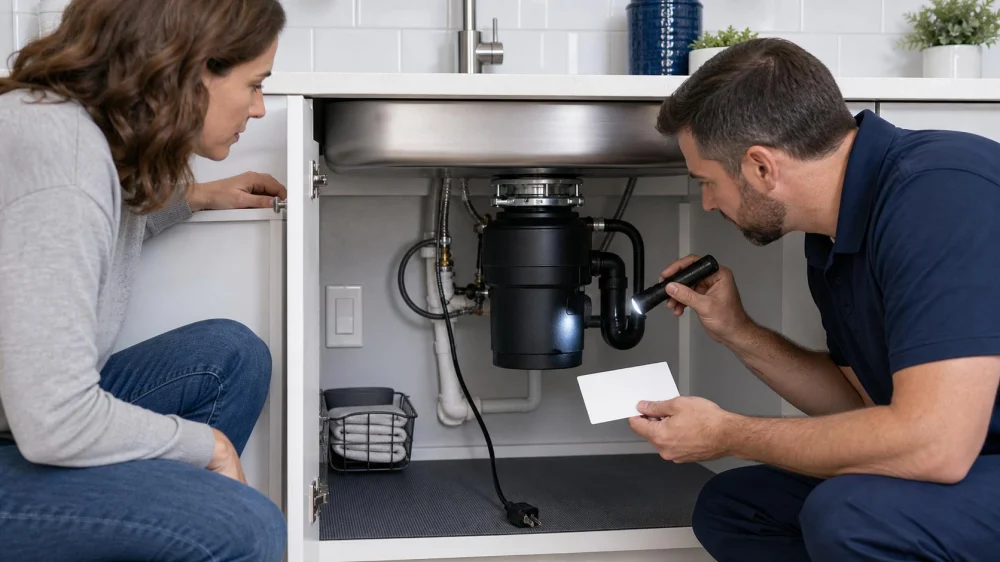
A garbage disposal that hums without turning may be jammed, mechanically failed, or receiving power without starting correctly. Switch it off immediately to avoid overheating. Never put a hand, utensil, or tool through the sink opening. Isolate electrical power using the unit’s plug or the correctly identified breaker before any visual inspection.
Do not repeatedly toggle the wall switch or press the reset button while it hums. Find the model information and manufacturer instructions, clear the sink area, record whether water drains, and call a plumber or qualified appliance/electrical professional when the jam cannot be handled exactly as the manual describes.
Stop and isolate power
Turn the disposal switch off. If the unit plugs into an accessible receptacle, unplug it without touching wet surfaces. If it is hardwired or the plug is inaccessible, use the correctly labeled circuit breaker. If the circuit is uncertain, stop and have a qualified person isolate it. A wall switch in the off position alone is not proof that the equipment is de-energized.
Keep children and other occupants away. Remove standing objects around the sink, but do not reach into the grinding chamber. If there is smoke, a burning odor, sparking, a hot cord, water at electrical parts, or a tripped breaker that will not stay reset, leave power off and request urgent qualified service.
Sturgeon Plumbing & Gas Services LLC
2044 Mack Ave SW, Cullman, AL 35055, USA
Record the symptom
Note whether the sound began after a specific item entered the drain, whether the unit stopped abruptly, whether the sink drains slowly, and whether another appliance lost power. Record leaks under the sink, odor, breaker or GFCI behavior, and the approximate operating time before shutdown. A short video from a safe distance can help a professional, but do not energize the unit again just to make one.
Photograph the data plate, plug, switch location, discharge piping, dishwasher hose connection, and any visible leak without removing covers. Model-specific instructions matter because reset location, approved unjamming method, and tools differ.
Use only safe external checks
- Verify that the wall switch is off and power is isolated.
- Wait for the motor to cool according to the manufacturer’s instructions.
- Use a flashlight from above to look for a visible foreign object without reaching inside.
- Check under the sink for leakage, loose piping, or a damaged cord without touching exposed electrical parts.
- Read the manufacturer’s official jam-clearing and reset sequence for the exact model.
- Use only the designated external turning tool or method if the manual explicitly permits it and power remains isolated.
- Restore power and test only if every step is complete, the area is dry, and no hazard remains.
Never substitute fingers, a kitchen knife, broom handle, improvised wrench, or chemical drain cleaner. Do not disassemble the disposer body or wiring as a trial repair.
Know when to call
Call a plumber when the unit remains stuck, leaks at plumbing joints, drains poorly, or must be removed. Call a qualified electrician or appliance professional for damaged wiring, recurring breaker or GFCI trips, sparking, heat, or uncertain power isolation. A combination problem may require both trades.
The U.S. Consumer Product Safety Commission’s home electrical safety checklist provides general electrical warning guidance. For the disposal itself, follow the current manual and local electrical and plumbing rules.
Service checklist
- Switch turned off immediately
- Plug or correctly identified breaker isolated
- No hands or tools inserted through sink opening
- Smoke, heat, sparks, leaks, and breaker behavior recorded
- Model and data plate photographed
- Official manual located
- Only approved external method considered
- Correct trade called for plumbing or electrical symptoms
Limitations
This guide cannot confirm that a circuit is de-energized, identify an internal failure, or authorize repair. Disposal designs and electrical connections vary. The manufacturer instructions, local code, and a qualified onsite assessment control.
FAQ
Why not keep flipping the switch?
A stalled motor can heat quickly, and repeated attempts do not remove the cause.
Can tongs remove an object?
Do not insert anything unless the exact manual permits a method and power has been safely isolated. Professional service is the safer choice when uncertain.
Should I use drain cleaner?
No. It may create chemical exposure and complicate service without correcting the mechanical fault.
Can I press the reset button?
Only after following the manufacturer’s sequence and resolving the cause. A reset is not an unjamming tool.
Who repairs a disposal?
Plumbers commonly handle the unit and drain connections; electrical faults require an appropriately qualified professional.
Evidence notes
The best case evidence is the exact model manual, data-plate photo, breaker and GFCI behavior, sound description, timing, leak location, and any item known to have entered the unit. General online advice cannot replace model-specific isolation and service instructions.
Conclusion
A humming disposal is a stop signal. Switch it off, isolate power, keep hands and improvised tools out, document the symptom, and use only the exact manufacturer procedure. When the cause or electrical state is uncertain, leave it off for qualified service.

 Aaron's Plumbing4.0 (658 reviews)
 JS Plumbing4.0 (60 reviews)
 Rapid Plumbers Irvine5.0 (14 reviews)
 Plumb Rite4.0 (38 reviews)
 Speedy Sewer & Plumbing3.0 (5 reviews)
 LC Doctor Plumber Inc.5.0 (12 reviews)
 How to Replace an In-Line Check Valve: A Step-by-Step Guide for Homeowners
 Plumbing Maintenance Tips to Avoid Expensive Repairs
 How to Replace an In-Wall Shower Drain
 When Multiple Slow Drains May Signal a Main Sewer Problem
 How to Replace a Mixing Valve for Tempered Water
 How to Install a New Sink Faucet: A Beginner’s Guide