
Why a Faucet Aerator Keeps Clogging With Debris
In this guide
A faucet aerator is the small screen assembly at the tip of many taps. It shapes the stream, mixes air into the flow, and often limits water use. Its mesh also catches particles moving through the faucet, so a clogged aerator may be the first place a homeowner notices scale, sediment, deteriorating rubber, or corrosion debris. Cleaning restores flow, but repeated clogging is a clue that the source needs to be identified.
Ted Serjak Plumbing & Drain Cleaning
BessemerLawrence CountyPennsylvania
607 E Poland Rd, Bessemer, PA 16112, USA
Quick answer
If one aerator keeps clogging, compare hot and cold flow and inspect that faucet's removable screen, supply hoses, and internal parts. If several fixtures collect similar debris, contact the water utility or a licensed plumber, especially after utility work, a pressure change, a filter failure, or long vacancy. Photograph and save a sample before discarding it. The U.S. Environmental Protection Agency recommends cleaning aerators because sediment, debris, and lead-containing particles can collect there. Do not assume appearance identifies a contaminant; water-quality concerns require information from the utility, health department, or a qualified laboratory.
What the aerator does
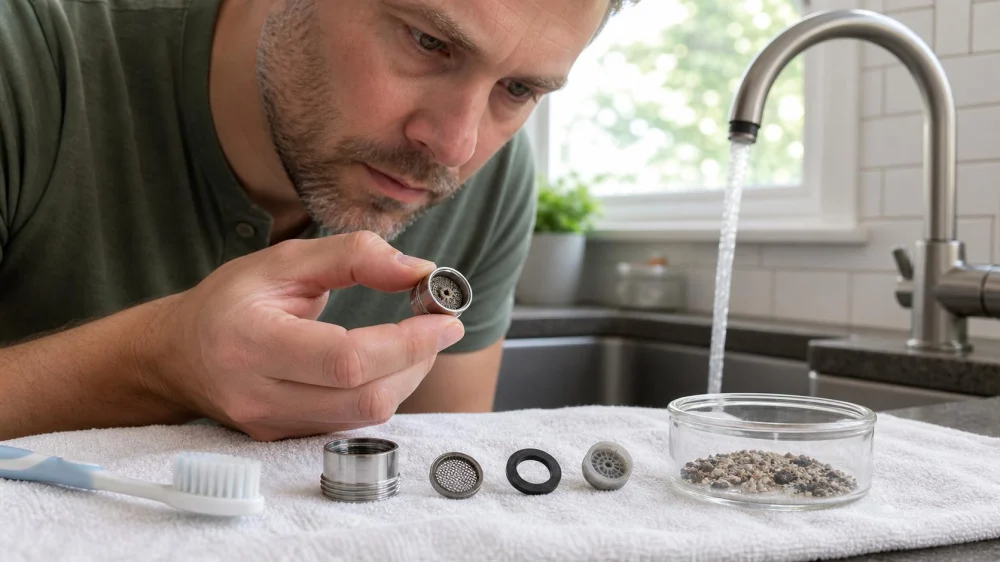
An aerator contains a housing, screen or mesh, flow-control insert, mixing components, and washers arranged in a specific order. Designs vary, and some modern faucets use recessed “cache” aerators removed with a matching key. The assembly produces a smoother stream and can reduce splashing and water use.
The screen is not a certified drinking-water filter unless the product is specifically designed and certified as one. It passively captures particles large enough to lodge in the mesh. As material accumulates, flow drops, the stream splits, or water sprays sideways. Removing the aerator may make flow look stronger while leaving the underlying debris source unchanged.
What different debris may suggest
Appearance can guide questions but cannot confirm composition.
- White or pale crust: often associated with mineral scale from hard water or dried deposits at the outlet.
- Tan or sandy particles: may be sediment disturbed in plumbing, a water main, a well system, or a water heater.
- Blue-green material: may be associated with copper corrosion products, but color alone is not diagnostic.
- Orange, red, or brown particles: may involve iron, rust, or sediment from steel components.
- Black flecks: can come from deteriorating rubber washers, supply hoses, filter media, manganese, carbon, or other sources.
- Clear or translucent fragments: may be plastic components, resin beads, or mineral pieces.
Do not taste, crush, burn, or chemically test unknown material at home. A photograph on white paper with a scale reference, the date, and the fixture location is more useful. Place a small sample in a clean sealed container if the utility, plumber, or laboratory requests it.
One faucet or the whole house?
Pattern is the fastest way to narrow the investigation. Check several fixtures without removing components from all of them at once. Compare kitchen and bathroom taps, different floors, and the fixture nearest the service entrance. Note whether the issue affects hot water, cold water, or both.
If only one faucet is affected, local causes become more likely: a deteriorating washer or cartridge, a damaged flexible connector, debris trapped after that fixture was installed, or corrosion at a nearby valve. If every hot-water aerator collects similar particles while cold taps remain clear, the water heater or hot-water piping deserves attention. If both hot and cold taps throughout the building show the same new debris, the source may be upstream in the building service or distribution system.
Multi-unit properties require coordination. Neighbors above, below, or on the same service line may see the same pattern. Report it to building management rather than modifying shared plumbing independently.
How to inspect and clean an aerator
- Protect the sink. Close or cover the drain so small parts cannot fall in, and place a towel over the basin.
- Identify the aerator type. Consult the faucet manual. Use the correct key for a recessed model.
- Remove gently. Turn by hand when possible. If pliers are permitted, protect the finish and avoid twisting the faucet body.
- Keep parts in order. Photograph each layer as it comes out. Do not reverse the flow regulator, screens, and washers.
- Inspect the material. Photograph recurring debris and save a sample before rinsing.
- Rinse and brush. Backwash screens under clean running water and use a soft, dedicated brush. EPA flushing guidance describes gentle brushing and, for hard-water buildup, a short soak in distilled white vinegar followed by rinsing.
- Replace damaged parts. Cracked inserts, hardened washers, and torn screens should be replaced with compatible components.
- Reassemble and test. Hand-tighten according to manufacturer guidance, run cold water, and check for leaks and an even stream.
Do not clean a drinking-water component with a brush used for other household tasks. Do not use wire tools that enlarge screen openings or damage plating. If the aerator will not loosen with reasonable force, stop before the faucet or plumbing twists.
Debris after plumbing or utility work
Water-main flushing, hydrant use, valve operation, repairs, meter replacement, and household repiping can change flow and dislodge accumulated material. Installers normally flush new work before returning fixtures to service, but particles may continue to reach aerators temporarily. Ask the contractor or utility whether work occurred and what flushing procedure it recommends.
Follow official instructions rather than opening every fixture randomly. A utility may specify which outlet to use first, whether to remove aerators, how long to flush, and when water can be used for drinking. EPA residential flushing materials describe starting at an appropriate outlet and inspecting aerators, but site-specific directions take priority.
Do not run hot water to “flush the main” unless instructed. That can draw sediment into the water heater and wastes energy. Protect appliances, filters, ice makers, and treatment equipment according to manufacturer and utility guidance during major flushing events.
When water quality needs attention
Aerator debris matters because plumbing particles can affect drinking water. EPA's lead in drinking water guidance says sediment, debris, and lead particles can collect in aerators and recommends regular cleaning. Lead cannot be seen, tasted, or smelled, so a clean-looking stream does not prove its absence.
If lead or another contaminant is a concern, contact the public water system and local or state health department for current advice. Use a laboratory certified by the appropriate state authority for drinking-water testing. Sampling instructions matter: removing or cleaning an aerator immediately before a compliance or diagnostic sample can change what the sample represents. Tell the laboratory or official about the debris and follow its protocol exactly.
Until you receive guidance, use only cold tap water for drinking, cooking, and infant formula, as EPA recommends; heat it separately when needed. A filter must be certified for the contaminant of concern, installed correctly, and maintained on schedule. Boiling does not remove lead and can concentrate some dissolved contaminants as water evaporates.
Check worn fixture components
Black flecks isolated to one faucet can come from a degrading rubber washer, O-ring, cartridge, or flexible supply connector. Turn off the fixture's stop valves only if they operate normally and you know how to restore service without leaks. Older valves may fail when disturbed. When in doubt, have a plumber inspect the assembly.
A recently installed faucet may contain manufacturing debris or pipe-joint material dislodged during work. Excess thread-seal tape should not be inside the waterway. Corrosion at a stop valve or connector can produce recurring particles. Replacing only the aerator screen will not stop material being generated upstream.
Use potable-water-rated replacement parts listed for the faucet and local code. A generic connector that happens to fit can introduce compatibility, pressure, temperature, or material problems.
Consider filters and water heaters
A whole-house filter, softener, or other treatment device can release media when a component fails, is installed backward, or is serviced incorrectly. Resin beads, carbon granules, and fragments vary in appearance. Bypass or service treatment equipment only according to the manufacturer or a qualified water-treatment professional.
Water heaters accumulate sediment, and internal components can deteriorate. A hot-water-only pattern, rumbling, colored hot water, or particles after heater maintenance warrants professional assessment. Flushing a heater involves burn, pressure, gas, electrical, and flood hazards; follow the manufacturer and use a licensed plumber when the procedure is outside your experience.
Private wells add possibilities such as sand, pump issues, pressure-tank problems, or treatment-system media. The well owner is responsible for testing and maintenance. Contact the local health department, well professional, or extension service for regional guidance.
Mistakes to avoid
- Discarding the evidence immediately: Photograph and save recurring particles first.
- Assuming color proves composition: Several materials can look alike.
- Leaving the aerator off permanently: It may increase splashing and water use and does not resolve the source.
- Overtightening: The housing, threads, or faucet finish can crack or distort.
- Flushing through hot water without guidance: This can move debris into appliances and waste energy.
- Installing an uncertified filter: Choose certification for the specific contaminant and maintain it.
- Cleaning immediately before a planned water test: Ask the laboratory how the sample should represent normal use.
Who to call and what to report
Call the water utility when similar debris appears suddenly at several cold-water taps, neighbors are affected, pressure or color changed, or nearby main work occurred. Call a licensed plumber when the issue is isolated to the building, hot-water-only, tied to a fixture or connector, or accompanied by leaks, pressure problems, or failing equipment. Contact the health department for contaminant and testing guidance.
Provide a concise report:
- when the problem began and whether it is continuous or intermittent;
- which fixtures and units are affected;
- whether particles appear on hot, cold, or both;
- recent plumbing, utility, filter, or heater work;
- changes in pressure, color, odor, or taste;
- clear photographs and a retained sample;
- the building's age and service-line information if known.
Seek urgent guidance if water has an unusual chemical or fuel odor, causes illness, arrives with an official advisory, or may be affected by a cross-connection or backflow event. Follow emergency notifications from the utility and public-health authorities.
Frequently asked questions
Can vinegar clean an aerator?
A short soak in distilled white vinegar can help dissolve hard-water buildup on compatible parts, followed by thorough rinsing. Check the faucet manufacturer's instructions because finishes and components vary.
Why is water pressure low at only one faucet?
A clogged aerator is a common cause, but a partially closed stop valve, kinked connector, cartridge problem, or local debris can also restrict flow. Compare flow with the aerator removed only as a brief diagnostic step.
Are black flecks always from a rubber washer?
No. They may come from rubber, filter media, corrosion products, manganese, or other material. Pattern and professional evaluation are needed.
Should I test for lead if debris appears?
Ask the water utility and health department about local risk and testing. Lead is invisible, so debris appearance cannot confirm or rule it out. Use a state-certified laboratory and follow sampling instructions.
How often should an aerator be cleaned?
EPA recommends regular cleaning, but the practical interval depends on water conditions and fixture use. Inspect when flow changes and establish a schedule based on what you find.
Treat recurrence as evidence
Cleaning a clogged aerator is routine maintenance; cleaning the same debris repeatedly is an investigation. Compare fixtures, separate hot from cold, document the material, and consider recent work, local components, treatment equipment, and utility conditions. Use EPA and local public-health guidance for drinking-water concerns, and involve a plumber when the pattern points to building plumbing. A clean screen restores the stream, but identifying the source protects the system behind it.



 Trader Plumbing4.0 (21 reviews)
 Rooter Plumbing & Sewer4.0 (42 reviews)
 Mighty Plumbing5.0 (8 reviews)
 Lighthart Co3.0 (2 reviews)
 Airport Plumbing5.0 (19 reviews)
 Reliable Clog-Rod-Drain Specialists4.0 (64 reviews)
 How to Install a New Pipe System for Your Home: Step-by-Step Guide
 How to Reroute a Plumbing Run Over a Crawlspace: A Step-by-Step Guide
 How to Replace the Gasket on Your Toilet Tank and Prevent Leaks
 How to Use a Drain Snake Without Damaging Pipes | Plumbers Supply Hub
 How to Prevent Toilet Clogs: Simple Tips Every Homeowner Should Know
 What Causes Discolored Water and When to Worry