
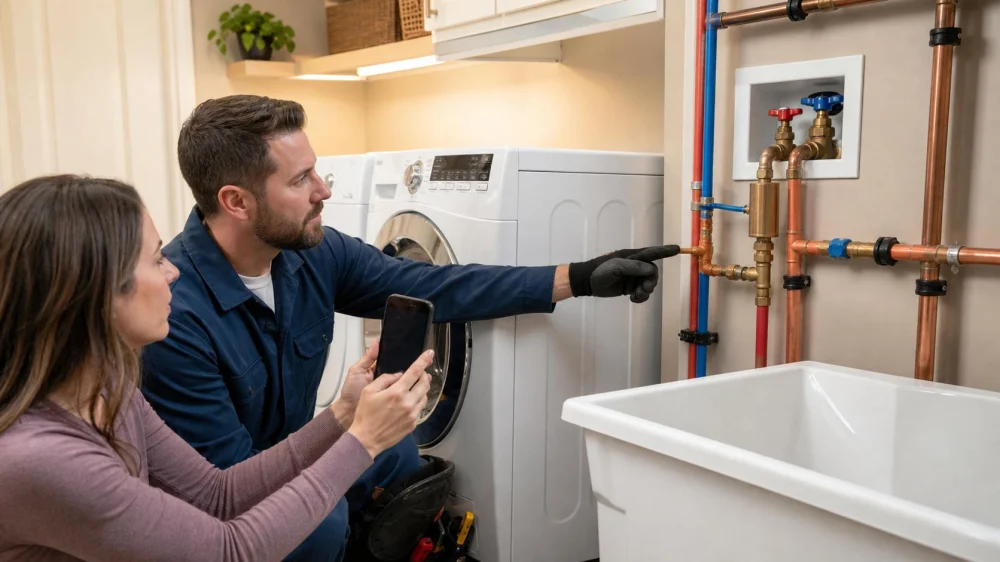
Water Hammer or Pipe Noise? How to Tell the Difference
Quick answer
A single bang immediately after a fast-closing faucet, washing machine, dishwasher, toilet valve, or irrigation valve often suggests water hammer. Rattling during flow may point to loose pipe supports; ticking as hot water starts or stops can be thermal expansion; continuous hissing may indicate a leak or valve problem. Record which fixture triggers the sound, then have pressure, valves, supports, and arresters evaluated if it is strong or recurring.
Water hammer is a pressure wave created when moving water stops or changes velocity suddenly. The shock can travel through supply piping and create a bang, vibration, or movement.
Match the sound to the event
- Sharp bang at shutoff: Common water-hammer pattern, especially with quick-closing appliance solenoid valves.
- Repeated knocking while water runs: May involve a loose pipe, pressure fluctuation, valve component, or another mechanical issue.
- Ticking or creaking with hot water: Pipes may be expanding and rubbing against framing or tight penetrations.
- Gurgling from a drain: This concerns drainage or venting, not water hammer in a pressurized supply line.
- Hissing when fixtures are off: Check for a running toilet, leaking valve, or concealed leak and act promptly.
A safe homeowner diagnostic checklist
- Note the exact sound, location, time, and fixture action that starts it.
- Run one fixture or appliance at a time to isolate the trigger without repeatedly stressing the system.
- Observe accessible supply hoses, shutoff valves, and exposed pipes for movement or leaks. Do not open walls.
- Check whether the noise began after a new appliance, valve, pressure regulator, water heater, or plumbing alteration.
- Ask a plumber to test static and flowing pressure with proper equipment; do not adjust a regulator blindly.
If a pipe is leaking, a fitting has shifted, or water appears near electrical equipment, stop using the affected fixture. Shut off water only if you can do so safely and know the correct valve; otherwise call for urgent help.

Wepking Pump Service Inc.
LancasterGrant CountyWisconsin
10526 Liberty Ridge Rd, Lancaster, WI 53813, USA
How the likely fixes differ
Water hammer: A plumber may correct excessive pressure, repair a failing pressure-reducing valve, service a fast-closing fixture valve, or install and size an engineered water-hammer arrester near the correct branch or fixture.
Loose piping: Accessible pipes may need compatible supports that secure the line while allowing normal expansion. Over-tightening or using the wrong fastener can damage pipe.
Thermal movement: The solution may involve clearance, sleeving, support changes, or system design—not simply clamping the sound away.
Old air chambers: Some homes have capped pipe chambers intended to cushion shock. They can become waterlogged and are not the same as a sealed, engineered arrester. Do not assume draining the house is a durable or code-compliant repair.
When professional evaluation matters
- The bang is severe, frequent, or affects several fixtures.
- Pipes visibly jump or supports are damaged.
- There is a leak, corrosion, pressure-relief discharge, or water staining.
- The noise began after plumbing work or a new appliance.
- You suspect high pressure, a failing regulator, or an expansion-control problem.
- The pipe is concealed, near electrical equipment, or difficult to access.
Arrester selection and placement depend on fixture demand, pipe layout, connection type, code, and manufacturer instructions. A random device added far from the trigger may not solve the cause.
Evidence note: The U.S. Department of Energy defines water hammer as a liquid shock wave caused by sudden starting or stopping of flow and notes that strong events can damage piping and supports. Manufacturer instructions likewise require arresters to be sized and placed for the system and local code. This article is general troubleshooting guidance, not a plumbing design or pressure diagnosis.
Frequently asked questions
Can high water pressure cause banging pipes?
It can increase stress and worsen some hammer events, but sound alone cannot establish pressure. A proper pressure test and system evaluation are needed.
Why does the washing machine trigger the noise?
Its electrically operated valves can stop flow quickly. The appliance valve, supply pressure, hose condition, pipe support, and arrester arrangement may all matter.
Is water hammer only an annoyance?
No. Mild noise may persist without immediate failure, but strong repeated shock can stress valves, joints, hoses, and supports. Investigate recurring events.
Will closing a shutoff valve partway fix it?
Do not use a partially closed stop as a universal fix. It may create noise, restrict flow, or damage some valve types. Have the actual cause identified.
Next steps
Record a short video that captures the triggering fixture and sound, inspect only accessible areas, and note recent plumbing changes. Give that evidence to a plumber and ask for a diagnosis that distinguishes pressure shock, loose supports, thermal movement, and valve noise before approving a repair.
 Hudson Plumbing4.0 (466 reviews)
 Papa Micks Plumbing4.0 (46 reviews)
 Great Lake Plumbing Service Inc.4.0 (12 reviews)
 Cedar Bluff Plumbing4.0 (68 reviews)
 Sinclair Plumbing, Inc.4.0 (61 reviews)
 Dj's Plumbing LLC5.0 (1 reviews)
 What Causes Discolored Water and When to Worry
 How to Choose Bathroom Plumbing Fixtures for Your Remodel
 How to Replace a Mixing Valve for Tempered Water
 Water Hammer or Pipe Noise? How to Tell the Difference
 How to Replace Your Showerhead and Improve Water Flow
 How to Install Plumbing for a Basement Bathroom - Step-by-Step Guide