
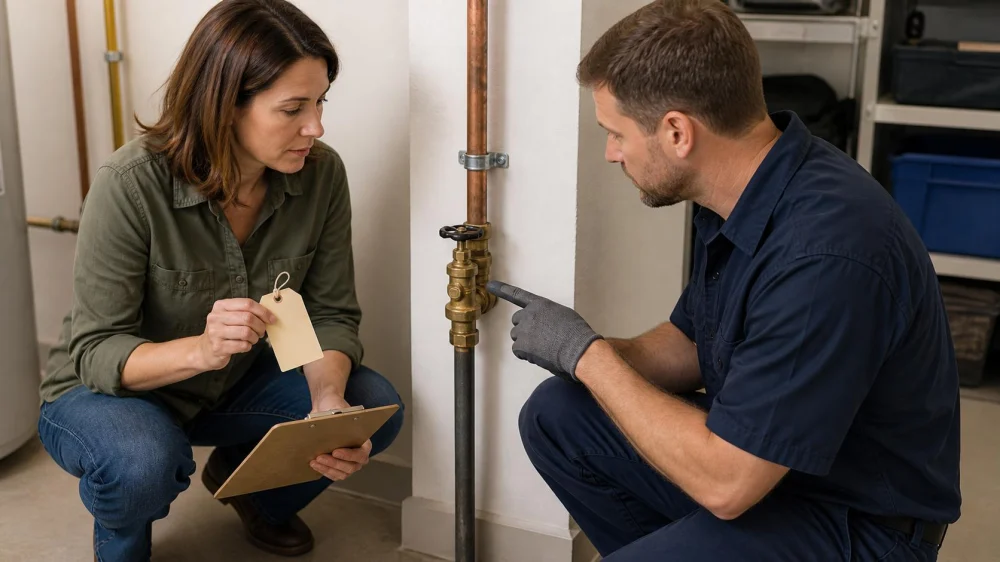
Main Water Shutoff Check: Locate, Label, and Plan Access
Table of contents
Quick answer: Find the building's main water shutoff before a leak occurs, but do not guess or force an unfamiliar valve. Trace the incoming service with a plumber, confirm whether the valve controls the whole home, clear permanent access, add a durable label, and record photos and operating directions. Arrange a supervised test when water interruption will not damage equipment or disrupt other occupants.

Identify the correct shutoff
The main shutoff is on the building's water service, but location varies. It may be near where service enters a basement, crawlspace, utility room, garage, or exterior wall. An outside utility valve is not automatically homeowner-operated.
Check inspection reports, builder documents, or plumber notes. Gas, irrigation, fire-suppression, heating, and appliance pipes can be mistaken for domestic water. If identification is uncertain, ask a licensed plumber or utility.
In multi-unit buildings, a valve may serve one fixture, apartment, stack, or the building. Contact management before touching shared equipment, and record who may authorize shutdown and notify occupants.

Klasinski Plumbing & Heating
Stevens PointPortage CountyWisconsin
5001 Coye Dr, Stevens Point, WI 54481, USA
Inspect without forcing the valve
Look for corrosion, deposits, moisture, staining, handle damage, unsupported pipe, or blocked access. Photograph the valve and wider room so another person can find it.
Do not use a wrench or extension bar to overcome a stuck handle. Extra leverage can break a stem, fitting, or weakened pipe and turn a preparedness check into an active leak. Do not paint the moving parts, hang heavy objects from the valve, or cover it behind finished construction without suitable access.
Record valve style and operating direction only after confirmation. Quarter-turn and multi-turn valves differ; a visual rule is unsafe without identifying the valve.
Plan a controlled test
A valve may not close fully or may leak when disturbed. Ask a plumber whether testing, repair parts, replacement planning, utility coordination, and cleanup preparation are appropriate. Test when help is available.
- Notify all affected occupants and pause water-using appliances.
- Confirm special systems that require water or a restart procedure.
- Have the plumber operate the valve using the correct method.
- Verify loss of flow at an appropriate fixture without opening equipment.
- Reopen slowly as directed and check the valve and nearby joints for leaks.
- Confirm normal flow and document the result and test date.
Do not use a casual whole-house shutdown to troubleshoot a water heater, boiler, fire sprinkler, well, treatment system, or other specialized equipment. Those systems may need separate controls and restart instructions.
Label the route and share the plan
Place a clear, moisture-resistant label near the confirmed valve without interfering with movement or inspection. Add a simple arrow at decision points if the route is not obvious. Avoid attaching a tag that could fall into machinery or conceal corrosion.
Create a short record with a wide-location photo, close-up photo, valve purpose, operating direction, test date, plumber and utility contacts, and any warning such as “shared building valve—manager authorization required.” Store a copy where household members can reach it without relying on a locked phone.
Keep the route free of boxes, shelving, locked panels, snow, vegetation, and stored chemicals. Anyone expected to respond should walk the route in normal lighting and know which valve not to touch.
Know the emergency boundaries
During an active leak, protect people first. Keep away from sagging ceilings, contaminated water, and water near electrical equipment. If it is unsafe to reach the confirmed shutoff, leave the area and call emergency services, the utility, property management, or a plumber as appropriate. Never enter a flooded space to operate a valve.
A curb stop, meter valve, sealed utility device, or fire-protection valve may require utility or authorized personnel. Do not improvise a key, break a seal, or close a valve whose ownership and function are unknown. The preparedness plan should list the correct call for an inaccessible or failed building shutoff.
Frequently asked questions
Should the main shutoff be turned every year?
There is no universal interval. Valve type, age, condition, water quality, manufacturer guidance, and local practice matter. Ask a plumber for an inspection and test schedule.
What if the valve closes but water still flows?
A fixture may be draining stored water, another supply may exist, or the valve may not seal. Do not apply extra force; have a plumber diagnose it.
Is the valve beside the water heater the main shutoff?
Not necessarily. It may isolate only the heater. Confirm pipe routing and valve purpose before labeling or operating it.
Can I hide the valve behind a removable panel?
Access must remain suitable for inspection and operation and comply with applicable requirements. Review the enclosure plan with the plumber before building it.
Next steps
Book a plumbing walkthrough if the main shutoff is unidentified, obstructed, corroded, leaking, or untested. Ask the plumber to confirm the valve, demonstrate normal operation, assess replacement needs, and identify utility boundaries. Then label it, save photos and contacts, clear the route, and review the plan with every responsible occupant.
 Monkey Wrench Plumbing, Heating, Air & Electric4.0 (278 reviews)
 Bear Repairs5.0 (358 reviews)
 Rooter Hero Plumbing & Air of La Habra4.0 (195 reviews)
 Elmer's Plumbing3.0 (10 reviews)
 Big Cox Plumbing5.0 (5 reviews)
 Frank Romei & Son Plumbing4.0 (21 reviews)
 The Pros and Cons of Replacing Your Plumbing System: Expert Insights
 How to Replace a Faulty Pressure Relief Valve
 Plumbing 101: A Beginner’s Guide to Home Plumbing Repairs
 The Best Ways to Install Plumbing in Your New Construction Project
 How to Install a Washing Machine: A Complete DIY Guide
 How to Clear a Clogged Shower Drain: Effective Tips for Homeowners | Plumbers Supply Hub