
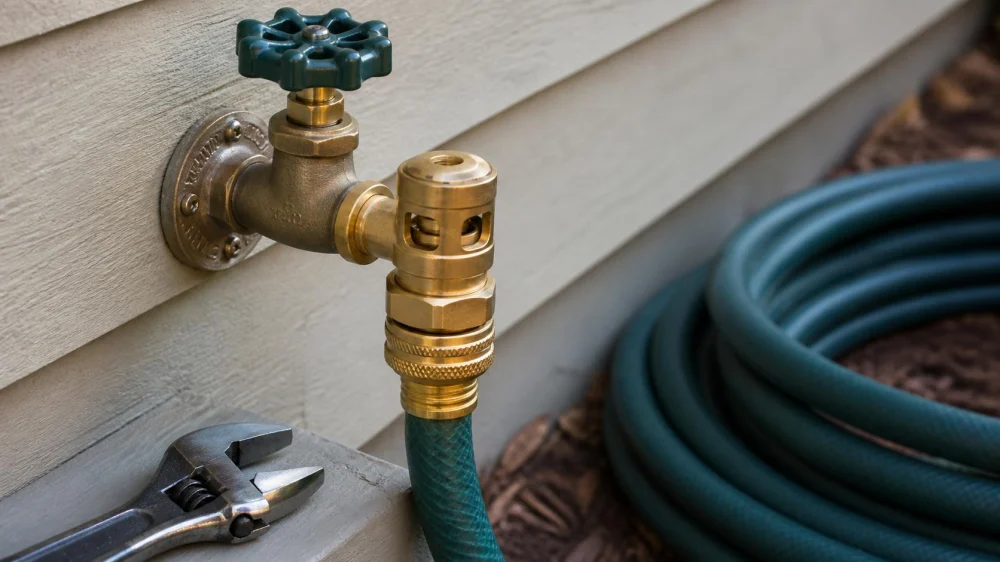
Hose Bib Vacuum Breaker Leaks: Check Fit, Freeze Damage, and Replacement
On this page
Quick answer
A hose bib vacuum breaker may release a brief spray when water shuts off, but continuous leaking, a loose body, freeze cracking, or poor flow deserves inspection. Disconnect the hose, close the faucet, note exactly where water appears, and check whether the device is an integral part, a threaded add-on, or secured with a breakaway screw. Do not remove required backflow protection or force a corroded fitting. A plumber can match an approved replacement and inspect the faucet and supply line.

Hiller Plumbing, Heating, Cooling & Electrical
2555 Pulaski Hwy, Columbia, TN 38401, USA
Why it matters
The device helps prevent contaminated hose water from moving backward into the potable system. Leaks may come from seals, threads, pressure, freezing, the faucet itself, or a damaged connection inside the wall.
This United States plumbing guide is general. Plumbing codes, backflow requirements, faucet design, water pressure, climate, ownership, and replacement rules vary. Follow local code and manufacturer instructions.
Plumb Rite Plumbing
Rancho CucamongaSan Bernardino CountyCalifornia
9495 E 9th St STE E, Rancho Cucamonga, CA 91730, USA
Practical checklist
- Disconnect attachments and identify whether leaking occurs while on, at shutoff, or while off.
- Dry the assembly and locate water at the vent, threads, stem, body, or wall.
- Look for cracks, distortion, mineral deposits, movement, and freeze history.
- Check whether a set screw or tamper-resistant feature is present.
- Confirm indoor shutoff access and whether the line is shared.
- Photograph markings and measure connection size without removing protection.
- Ask about approved replacement and required testing.
Step-by-step plan
- Close the faucet normally without overtightening and remove the hose to eliminate trapped pressure.
- Dry the parts, then run a brief controlled test while watching from a safe position.
- Record whether water exits the vacuum-breaker vent only during shutdown or continues afterward.
- Stop if the faucet moves at the wall, a crack opens, or water appears indoors.
- Do not drill a set screw, defeat a check mechanism, or substitute an ordinary coupling.
- Have a qualified plumber isolate the line and replace the correct serviceable component or faucet.
- Retest for shutoff, drainage, leakage, stable wall connection, and proper seasonal protection.
Save photos, device markings, leak location and timing, weather and freeze history, water-pressure information, shutoff location, parts used, permits or code notes, invoice, and final test.
Limits and warning signs
A vent discharge at shutoff can be normal for some designs, but online observation cannot confirm function. Tape or sealant cannot repair a cracked body or substitute for required backflow protection.
Shut off the branch or main and call a plumber if water enters the wall, the faucet body moves, flow cannot be stopped, or freeze damage is suspected. Contact the water authority for cross-connection or code questions.
Frequently asked questions
Why does it spray when I turn the water off?
Some designs vent briefly as pressure changes; persistent or new discharge should be checked.
Can I remove the vacuum breaker?
Do not remove required protection; codes and device design may require an approved replacement.
Why will the device not unscrew?
A breakaway or locking screw, corrosion, or an integral design may prevent normal removal.
Should I leave a hose attached in winter?
Disconnecting hoses is commonly important for drainage, but follow the faucet and winterization instructions for your system.
Sources and evidence
The guide applies potable-water cross-connection, freeze-protection, pressure, and fixture-service principles: retain approved backflow protection, identify the leak point, avoid forcing secured components, and test after qualified repair.
Conclusion and next steps
Disconnect the hose, locate and document the exact leak, check for cracking or wall movement, and preserve the backflow device. Have a plumber match and test an approved repair when leakage persists.

 Smith's drain service llc5.0 (4 reviews)
 A Aart's Speedy Plumbing & Sewer4.0 (7 reviews)
 Ehmen Industries, Inc.4.0 (27 reviews)
 All-Pro Pittsburgh Backflow5.0 (55 reviews)
 Plumbing Specialists5.0 (4 reviews)
 McNamara Plumbing, LLC5.0 (6 reviews)
 How to Replace a Toilet That Wobbles After Installation
 How to Troubleshoot Your Sump Pump: Common Issues and Solutions
 How to Install a New Pipe System for Your Home
 Plumbing Repair Invoice: Check Parts, Labor, and Testing
 How to Repair a Slab Leak Under the Floor
 How to Replace a Broken Valve in a Water Line