
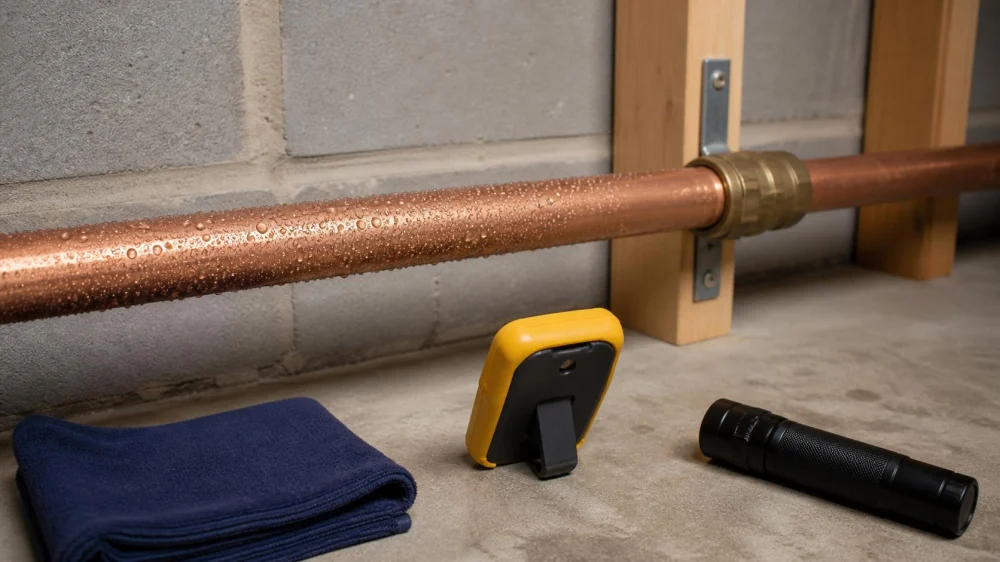
Cold Water Pipe Condensation or Leak? Record the Moisture Pattern First
On this page
Quick answer
Moisture spread broadly along a cold pipe during humid conditions can be condensation, while water that begins at one joint, valve, crack, or fitting may indicate a leak. Appearance alone is not enough. Keep people away from electrical hazards, dry the accessible surface, photograph the pipe, and record when moisture returns, where it starts, whether water is running, indoor humidity, and recent weather.
Treat ongoing wetness promptly because both leaks and condensation can damage nearby materials and support mold growth.
Warne Plumbing & Heating, LLC
WatertownCodington CountySouth Dakota
1121 19th St SE, Watertown, SD 57201, USA
Make the area safe
If water is near wiring, outlets, panels, lights, appliances, or powered equipment, do not touch wet surfaces or operate switches while standing nearby. Keep occupants away and contact qualified electrical and plumbing help. For active flooding, use a verified shutoff only when it is safe and you know it controls the affected water.
- Do not open walls or ceilings beneath suspected trapped water.
- Do not stand under bulging material.
- Protect children and pets from the area.
- Avoid breathing disturbed mold-like material.
- Escalate rapidly changing damage.
Observe the moisture pattern
Wipe only an safely accessible section dry and watch without disturbing joints or insulation. Condensation often forms as many small droplets on an exposed cold surface. A pressurized leak may repeatedly wet a precise connection, produce a bead or spray, or continue despite changes in room humidity.
- Mark the first visible wet location in a photograph.
- Note whether the whole pipe or one point becomes wet.
- Observe before, during, and after nearby water use.
- Check above the pipe for another water source.
- Do not tighten or loosen a fitting during the observation.
Record temperature and humidity clues
Condensation forms when warm humid air contacts a sufficiently cold surface. Note indoor relative humidity, room temperature, weather, air-conditioning operation, cooking, showering, clothes drying, and whether a door or vent recently changed airflow. Compare similar cold pipes in the same area.
A humidity meter can add context, but it does not prove the source. EPA recommends keeping indoor relative humidity below 60 percent and ideally between 30 and 50 percent when possible.
Look for leak-specific clues
Fresh mineral deposits, corrosion concentrated at a fitting, a recurring droplet at one point, a hissing sound, pressure changes, meter movement when no water is intentionally used, or damage following a plumbing event can increase concern for a leak. Water can travel along a pipe before dripping, so the lowest wet point is not necessarily the source.
Hidden piping, insulation, and wall cavities need professional tools and judgment.
Dry and protect nearby materials
Dry accessible hard surfaces and provide safe air movement or dehumidification while the source is assessed. Move dry belongings away from the area. Porous insulation, drywall, wood products, carpet, or stored items may retain moisture even after the pipe looks dry.
Do not seal wet material behind new insulation or paint. Address the water source before cosmetic repair.
Prepare for professional assessment
Share photographs, moisture start points, timing, humidity readings, affected fixtures, recent repairs, pipe material, insulation condition, and the location of shutoffs. Ask the plumber to identify the source before recommending insulation or repair.
If condensation is confirmed, a complete solution may involve humidity control, ventilation, air sealing, and correctly installed pipe insulation with sealed seams. If a leak is confirmed, repair the failed plumbing and verify the area dries.
Important limitations
This is general U.S. observation guidance, not plumbing, electrical, building-science, or mold-remediation advice. Moisture can come from multiple sources. Use qualified professionals for hazards, hidden damage, repeated wetting, large affected areas, or uncertain diagnosis.
Evidence notes
EPA moisture guidance explains that condensation can form when warm humid air contacts cold surfaces and recommends prompt drying and source control. It also identifies cold-water pipe insulation and humidity reduction as possible condensation measures. The observation log helps distinguish patterns before work begins.
FAQ
Do droplets along the pipe prove condensation?
No. They are a clue, but leaks and water from above can spread along piping.
Can a pipe leak only when a fixture runs?
Some leaks depend on flow or drainage, so timing is useful to record.
Should I insulate the pipe immediately?
Identify and repair leaks first; do not cover an unresolved moisture source.
What humidity level should I record?
Record the actual reading and conditions; EPA recommends below 60 percent, ideally 30–50 percent when possible.
Why does moisture matter if it is only condensation?
Repeated wetting can damage materials and support mold growth.
Next steps
Make the area safe, photograph the first wet point, dry the accessible pipe, log humidity and nearby water use, and check for recurrence. Arrange qualified assessment for persistent, localized, hidden, or hazardous moisture.


 Richards Rooter and Plumbing5.0 (107 reviews)
 Rick Adams Plumbing & Pools3.0 (45 reviews)
 Prieto plumbing5.0 (44 reviews)
 Jacobs Plumbing & Pump Service, LLC0.0 (0 reviews)
 Hal's Plumbing4.0 (23 reviews)
 A1 Rooter Service, LLC5.0 (72 reviews)
 How to Detect Plumbing Leaks Early to Avoid Expensive Repairs
 How to Maintain Your Plumbing System to Avoid Costly Repairs
 Toilet Runs Intermittently? Check the Flapper, Chain, and Fill Level
 What Causes High Water Bills and How to Fix It
 What Causes Plumbing Pipes to Freeze and How to Prevent It
 How to Replace a Float Valve in a Rain Barrel System