
Water Meter Leak Check: Record the Dial Before Calling a Plumber
On this page
Quick answer
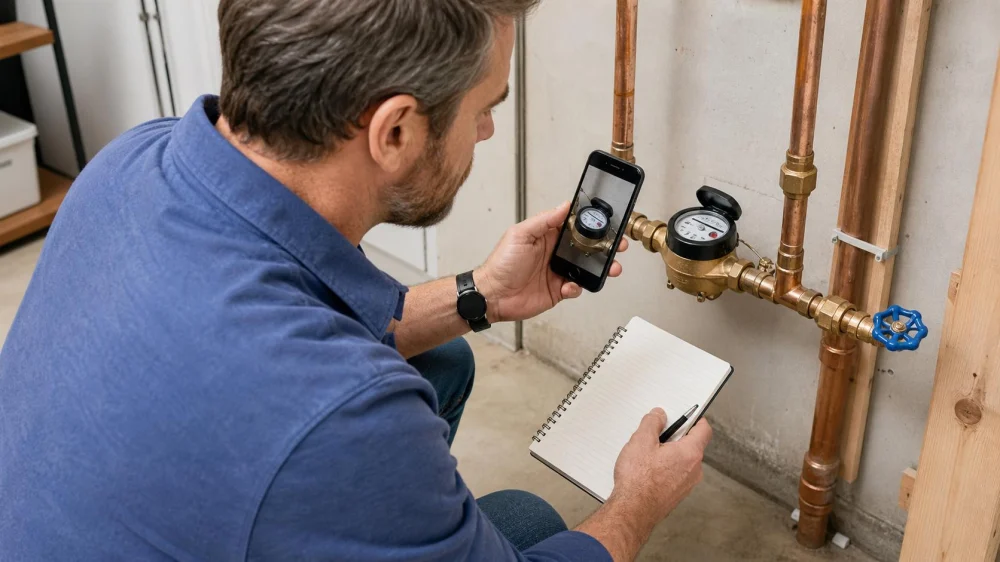
Choose a period when nobody will use water, turn off planned fixtures and water-using appliances without shutting the main supply, then photograph and write down the water-meter reading. EPA WaterSense recommends comparing the meter before and after a two-hour period of no water use. Any change probably indicates a leak or unaccounted water use.
A changing meter does not identify the location. Verify that toilets, irrigation, ice makers, humidifiers, filters, softeners, pools, and automatic appliances did not run. Report the readings, time, meter units, recent bills, and observations to the water utility or a licensed plumber. Do not open, remove, bypass, or tamper with sealed utility equipment.
Find the correct meter safely
Check the utility account, property records, or water provider instructions. A meter may be in a basement, mechanical room, garage, wall box, or underground pit near the street. Multifamily properties may use a master meter, submeters, or equipment inaccessible to residents.
Match the meter or transmitter number only when the utility provides a safe method. Never assume the closest lid belongs to your home. Avoid traffic, standing water, insects, snakes, sharp edges, confined spaces, and heavy covers.
If a cover requires a special tool, is too heavy, is locked or sealed, is in a roadway, or exposes wiring or a deep pit, stop and contact the utility. Do not reach into a flooded box or damage an automatic-reading device.
clogged toilet and drain guys
OshkoshWinnebago CountyWisconsin
1234 Liberty St, Oshkosh, WI 54901, USA
Prepare a true no-use period
Tell everyone in the home not to flush, wash, shower, run faucets, use the dishwasher or washing machine, fill pet bowls, make ice, water plants, or use outdoor fixtures during the test.
Pause scheduled irrigation, pool filling, water-feature make-up, softener regeneration, humidifiers, evaporative coolers, filtration backwash, and other automatic uses according to their manufacturer instructions. Do not disable safety equipment or medically necessary water.
Choose another time if guests, contractors, fire sprinklers, a shared supply, or building operations make zero use impossible. Record any equipment that cannot be paused so a professional can interpret the result.
Record the first and second readings
Take a clear photo that shows the entire display and units without revealing the address or account information publicly. Write the date, exact time, displayed reading, meter unit, and status of any small flow or leak indicator.
Do not press utility buttons unless the provider's instructions say to do so. Digital displays may cycle through screens or sleep; follow the utility guide. Analog meters can have several dials, and a sweep hand may represent a fraction of the displayed unit.
After two hours of verified no use, take a second photo from the same angle and record the exact time and reading. Keep both original images rather than editing the numbers onto one screenshot.
Interpret change without overdiagnosing
If the reading is identical, the test did not detect continuous use during that period. It cannot rule out an intermittent leak that was inactive, a very small change below the meter's displayed resolution, or water loss upstream of the meter.
If the reading changed, first verify accidental or automatic use. Then calculate the difference only using the correct units. Some utilities bill in gallons, cubic feet, or hundreds of cubic feet, and display formats differ.
Do not infer pipe location, repair cost, or severity from one test alone. A constantly running toilet, irrigation valve, appliance, service line, hot-water system, or another fixture can produce flow. A utility or plumber can help isolate it.
Narrow the source with safe observations
Walk the property without opening walls or excavating. Listen for running toilets, inspect visible faucet and showerhead drips, look under accessible sinks, check exposed supply connectors, and look around the water heater, washing machine, dishwasher, refrigerator, irrigation, and outdoor faucets.
Note damp cabinets, stains, warm floor areas, mildew odor, soft drywall, pooling, unusually green lawn patches, reduced pressure, pump cycling, or sounds when fixtures are off. Do not touch water near electrical equipment.
Closing individual valves can create leaks when old or damaged and may affect appliances or safety systems. Ask a plumber before operating unfamiliar valves. Never close a utility-owned curb stop or fire-system valve.
Prepare useful information for help
Give the utility or plumber:
- both photos, readings, units, and exact times;
- confirmation that no intentional water was used;
- automatic systems paused and systems that could not be paused;
- recent bills and any sudden usage change;
- visible moisture, sounds, pressure changes, or fixture problems;
- recent freezing, construction, appliance installation, irrigation work, or vacancy;
- location and accessibility of the main shutoff without operating it unnecessarily.
Ask the utility whether it offers high-use alerts, meter data, a customer leak adjustment, or instructions for its specific meter.
Frequently asked questions
Do I turn off the main water for the test?
No for the basic EPA comparison. The goal is to stop using water while leaving the system supplied so unintended flow can register.
What if the meter has a spinning triangle?
It may be a low-flow indicator, but designs differ. Consult the utility's instructions for that meter.
Can a refrigerator affect the test?
Yes. An ice maker or dispenser can use water automatically. Account for it or pause it safely according to instructions.
Does a stable meter prove there is no leak?
No. Intermittent or very small leaks may not appear during one test. Continue monitoring bills and symptoms.
Who owns the meter and service line?
Ownership boundaries vary by utility and location. Ask the provider before touching any meter, pit, curb valve, or service-line component.
Official sources and safety limits
EPA WaterSense's Fix a Leak Week guidance recommends checking a meter before and after two hours when no water is used; a change probably indicates a leak. WaterSense also describes leak detection and flow monitoring devices that can alert homeowners to irregular use or unexpected moisture.
This guide does not authorize access to utility equipment or diagnose a hidden leak. Contact the utility for meter access and a licensed plumber for repairs. Treat active flooding near electricity, structural damage, sewage, gas equipment, or loss of essential water as an urgent safety issue.
Next steps
Find the utility's meter-reading guide, choose a two-hour zero-use window, list every automatic water device, and capture two dated readings. If the meter moves after confirmed no use, protect property from active water, contact the utility or plumber, and provide the complete observation log rather than guessing at the source.
 Warwick Plumbing & Heating5.0 (175 reviews)
 The Amazing Plumber4.0 (259 reviews)
 Hinton Plumbing & Repair LLC4.0 (6 reviews)
 Matador Plumbing4.0 (7 reviews)
 Petro Plumbing & Mechanical Inc.4.0 (103 reviews)
 Shane Gibson Plumbing5.0 (31 reviews)
 How to Repair a Clogged Shower Drain Without Calling a Plumber
 The Most Common Plumbing Problems in Older Homes and How to Solve Them
 The Best Ways to Install Plumbing in Your New Construction Project
 How to Maintain Your Plumbing to Avoid Future Leaks and Clogs
 Top 10 Signs You Need a Plumber for Your Home’s Plumbing Problems: Essential Home Guide
 How to Repair a Broken Pipe Without Calling a Plumber Fast Fix Guide